
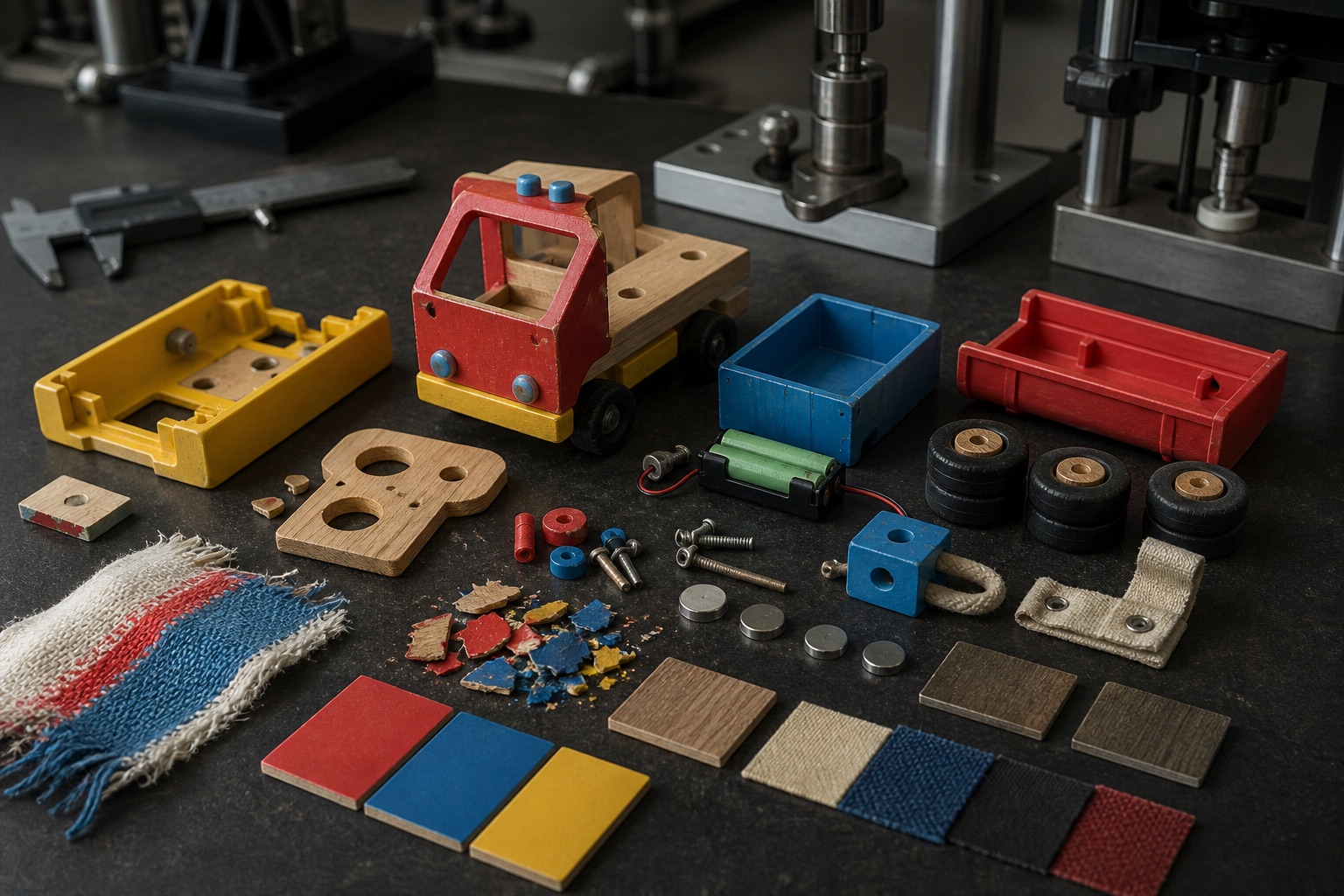
Supply chain model
See how Toys & Children’s Products moves.
Maintain one controlled record across product variants, safety assessments, laboratories, certificates, incidents, and imports.
01. Products
Toy models, age grades, color and electronic variants, sets, replacement parts, and children’s products
02. Materials
Polymers, paints, inks, textiles, wood, metals, magnets, batteries, electronic components, and packaging
03. Facilities
Component suppliers, molders, printers, assemblers, laboratories, importers, fulfillment centers, and marketplaces
04. Transactions
Model releases, production batches, laboratory orders, certificates, import entries, incident reports, and recalls
Evidence workflow in practice
Keep the tested product and the released product aligned.
Connect a toy model, production lot, laboratory results and certificate data through one controlled release decision.
- Toy manufacturerOwns product classification
- Component factoryControls production materials
- CPSC-accepted laboratoryPerforms required testing
- ImporterOwns entry and certificate use
01 InitiateOpen the exact case02 ResolveConnect identity and evidence03 CoordinateCheck, route, and prepare04 DecideKeep human authority05 ActIssue and reuse the outcome
Toy model
Open the safety workflow against the exact model and production lot.
- Input
- Model, age grading, materials and production lot
- Control
- The manufacturer or importer retains certificate responsibility; the laboratory owns its test results.
- Handoff
- Laboratory results · Testing laboratory
- Toy modelToy manufacturer
The released toy model is connected to the applicable test package, lot and certificate data.
Workflow boundary
CommonShare does not perform laboratory testing or issue the manufacturer’s legal certificate.
CPSIA — official source
Evidence in context
Keep proof close to the decision.
Bring every source record into one reviewable workflow.
A model-and-batch view tying components and factories to the applicable tests, warnings, certificates, market, and controlled passport record.
- Age grade: 6+
- 4 reports in force
- Batch linked to factory
- EU and US views separated
Connected capabilities
Move from intake to action.
Configure contributors, evidence, approvals, and audience views.
01. Multi-tier mapping
Connect products, suppliers, facilities, materials, and transactions across tiers.
02. Evidence governance
Extract, version, approve, and preserve documents with a reviewable audit trail.
03. Risk screening
Connect watchlist, sourcing, geography, and documentation signals to the right records.
04. Cases and corrective action
Route exceptions through cases, corrective actions, approvals, and escalation paths.
05. Digital product passports
Publish governed product records through QR experiences and role-based views.
06. Regulation-specific outputs
Prepare controlled statements, evidence rooms, certificates, assessments, and submission data.
Relevant pathways
Match the product to the rule.
Product scope, company role, material, transaction, market, threshold, and effective date determine the applicable pathway.
EU Toy Safety Regulation
A model-level safety DPP applies when the new regime replaces the current directive on 1 August 2030.
GPSR
General safety duties interact with the toy-specific framework.
CPSIA
US testing, certification, and import requirements are product-specific.
REACH & SCIP
Substance and article evidence depends on composition and thresholds.
PPWR
Packaging duties are distinct from toy safety and phase in by packaging format and operator role.
CSDDD
Company scope and chain-of-activities duties require entity-specific review.
EU Forced Labour
The product prohibition applies from 14 December 2027.
UFLPA
Applies to US imports exposed to the statutory presumption.
Frequently asked
What teams need to know.
No. The toy passport comes from the separate EU Toy Safety Regulation. The new regime is due to replace the current directive on 1 August 2030; that date should not be presented as an ESPR deadline.
Explore the family
More in Consumer & Lifestyle.
Follow adjacent products into their distinct evidence chains.
Apparel & Textiles
Footwear & Accessories
Beauty & Personal Care
Sporting & Leisure Goods
Consumer Goods & Housewares
Confirm your scope
Apply current legal text and implementing measures to your company role, products, materials, transactions, markets, and facts.